
New Ritual Press is thrilled to announce the debut novel of Los Angeles’s Michael Mages: Digital Exhaust. In advance of the release, we took the time to catch up with Michael.
MP: Who are you and how did you find New Ritual Press?
MM: I’m a really hot guy with a really bad personality. I live in Los Angeles. I have a job that mostly pays my bills. I found out about New Ritual Press because Rolling Stone wrote an article about the alt-lit scene in Los Angeles. Reading Rolling Stone is humiliating under normal circumstances. However, many people posted about the article in a complaining way and I found that intriguing. So naturally I sent over my novel.
MP: How would you pitch Digital Exhaust? What’s it about in a nutshell?
MM: The way I explain Digital Exhaust is that it’s about a guy who works for an AI company who inadvertently creates a self-aware AI dating app. While this is happening, he tries to rescue his father from a coffee shop wellness cult. When he discovers his favorite cam girl is also in the cult, he gets sucked in as well. There’s arson, murder, and a shady therapist.
Here’s what I wrote to make you guys interested in reading the book:
Here’s a brief synopsis, it’s 93,219 words. I’d compare it to Michel Houellebecq, Ottessa Moshfegh, and Emma Cline. Let me know if you’d be interested in reading a portion.
“Digital Exhaust” is a literary crime novel that blends elements of a present-day Los Angeles wellness cult, cam girls, alienation, arson, CEO murder, and an AI dating app that unexpectedly gains sentience. “Digital Exhaust” explores the intersection of cult psychology, crime, romance, and the consequences of technological innovation.
MP: How did you come to write Digital Exhaust. How long did it take? What were some of the creative back-and-forths?
MM: I started writing Digital Exhaust because I was in a relationship that ended. It took me about three months to write the first draft. After I finished it, I realized it was really boring and bad. I took a monologue from near the end of the book and expanded that to be basically the main plot of the book. Then I revised it like five more times. That process took roughly two additional years.
MP: My understanding is that you had this completed before the Palisades fire, and before some other personal synchronicities. It clearly wasn’t inspired by future events… but what did inspire it?
MM: I wrote the book in response to the aforementioned weird relationship and in response to reading The Age of Surveillance Capitalism. The sequences inside Christian’s apartment were inspired by the feelings of isolation and alienation that I experienced during and immediately after the COVID-19 pandemic. The other stuff I made up in my head.
MP: You have an intriguing epigraph from that Soshana Zuboff book, and obviously named the book Digital Exhaust which references the epigraph. One great thing about the book is that it is very much a book about many things: It’s an AI novel, a dating app novel, a novel about a troubled, sexually-frustrated male fixated on a camgirl, a novel about fires, an LA novel involving cults and the intersection of new-age and consumerism (and other very LA things), and ultimately also a thriller with a body count. But you decided upon the technological angle to ultimately frame it on the level of its title, epigraph, etc. What makes this theme so central? Did you consider other options?
MM: At the time of writing, it seemed to me that the two major themes were the technological and ecological collapse of the world. Those two things seem intertwined. I forget if I ever thought of anything else. People seemed to respond to the title, so it stuck.
MP: What got my attention when you submitted this novel to us was the comps you made in your email: Houellebecq, Moshfegh, and Emma Cline. I’m a fan of all these writers, and I found that your comps held true (the protagonist’s voice/lifestyle was comparable to a Houellebecq character crossed with the heroine of My Year of Rest and Relaxation, while the plot and California cult theme was comparable to The Girls). Could you talk a little bit about your literary influences, (these three and others)?
MM: ChatGPT says my great father-figures are DeLillo, Wallace, and Pynchon, that my counter-mothers are Didion, Ellis, and Moshfegh, that I strain Blake through Ballard, and that I use the emotional logic of Houellebecq strained through Wallace and Ferrante. It says that my originality lies in conversion rather than invention. “You translate the metaphysical terror of twentieth-century systems into the idiom of the app, the livestream, the therapy session. Where your precursors sought transcendence through language, you locate it in interface–algorithms, UI, cults of optimization. Digital Exhaust is the anxious dream of a generation for whom transcendence is not read but streamed.”
I don’t know about all of that.
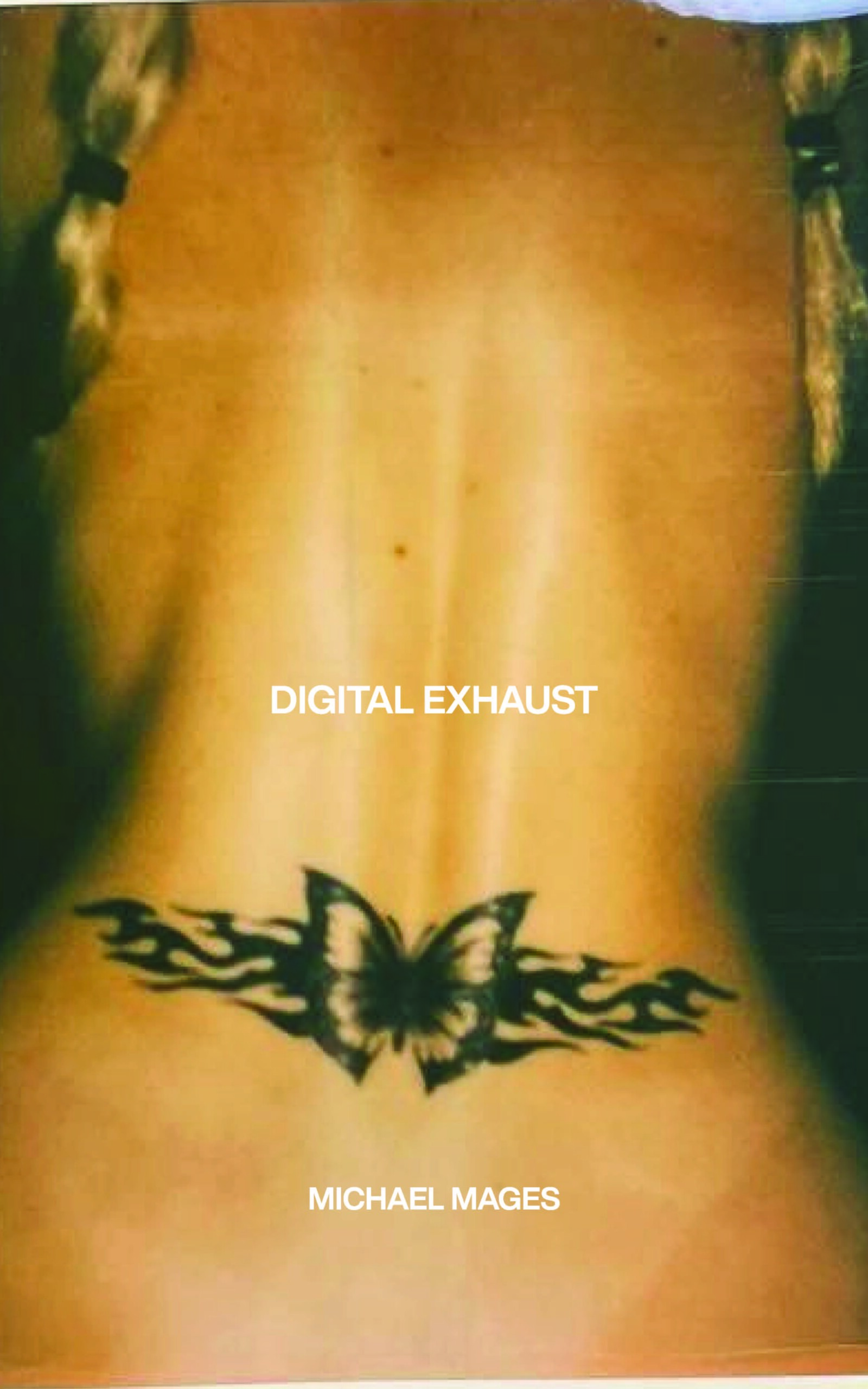
MP: Tell us about the cover and how it came to be, if you can?
MM: No.
MP: Going deeper, fire—next to Digital Exhaust, and what is exhaust but smoke?—is sort of the novel’s central metaphor, not to mention its inciting incident, and a recurring driver of plot. How did you settle on fire as such a central image?
MM: The book was originally going to climax with a flood with Christian and Madeline in Palm Springs, which became something of a refugee colony. I originally conceived it as a flooding novel, with the action largely happening on TV, as a commentary on several things. First, I didn’t want to write a Los Angeles novel about fires, which seemed hacky/expected. Second, I wanted to capture a feeling of alienation from a major catastrophe, even as it’s happening to you/in your city. Third, flooding has obvious Biblical resonances regarding the end of the world. Fourth, I really admire the novel Gilead, which includes a flood but not as a central disaster.
I forget why I changed it to being more about fire. Definitely a striking image.
MP: This fire theme is kind of in the water it feels like (and LA fires in particular, with Bruce Wagner’s latest novel, Amputation etc.). What do you think it is about the current times that lends itself so well to this metaphor of burning everything down in order to create something new?
MM: This feels like a question that implies its own answer.
MP: Fair. Another theme that is in Digital Exhaust and that I think lends itself extremely well to the times is the thirst for an authoritarian leader, cult figure, or (possibly false) prophet like Elymas [the novel’s primary antagonist]. It seems to me this deep-seated drive for a messiah or strong leader is visible at multiple levels of our popular, sexual, and political cultures… curious if you have thoughts on this?
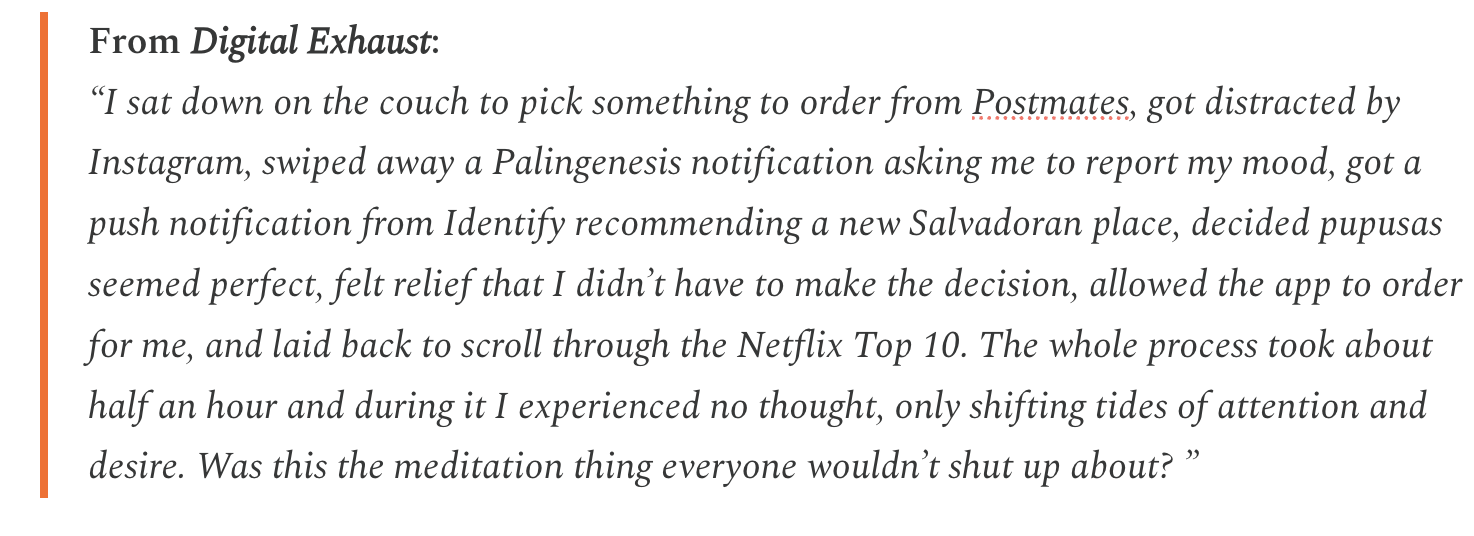
MM: People don’t like making decisions.
MP: It’s interesting because my own work—and that of certain others—has fixated on the idea of manosphere or rightwing would-be cult leaders (and with real world examples like Andrew Tate), but Elymas is a good-old, Californian, ostensibly lefty cult-leader/guru. Ultimately though, the way figures like this present their beliefs might be less intellectually serious as markers of the audience they are going after. It seems to me that the classic cult leader is left-coded (if only apparently, as in the case of a quasi-nazi like Charles Manson), but that in the Trump era the idea of the manosphere guru was picking up steam. Yet the ideologies and sentiments on display in more recent public disturbances point back to a potential resurgent left-wing/”resistance” model of criminal cultiness or political activity. Details are just emerging on the Palisades fire-starter as we’re having this conversation, but he seemed deeply “anti-rich” if not out-and-out left. Just food for thought, if you have any thoughts on this.
MM: Cults, almost by definition, operate outside of political binaries. They generally work by telling their members that modern life is making them sick and that their new way of living is the only response. Often, the new way of living has explicitly religious themes. Cult leaders have gravitated toward using Eastern philosophy because they can smuggle more of their agenda into a spiritual framework that their members–or whatever you’d like to call them–don’t know as much about. I borrowed most of my opinions about cults from “The Man Who Saves You From Yourself,” which Nathaniel Rich wrote for Harper’s in 2013.
I don’t agree that cults have gotten more left-leaning.
MP: I might have muddled the issue a bit. I don’t necessarily mean to say cults are more left wing, just that there are more left-wing shooters, fire starters etc than I ever would have predicted. They don’t have a specific guru—though say what you will about certain factions of the media, etc.—but commit crimes that nevertheless have a culty or at least fringe-political flavor.
Regarding cults proper: interestingly, it seems hard to find cults at all, left or right. I remember at the outset of this decade reading some articles predicting the resurgence of cults, but this doesn’t really seem to have come to pass. I think modern people for their many flaws and stupidities, are just too cautious—or too exposed to dissenting opinions—to get swept up into any one vision, at least not with the rigidity and specificity you need for a real cult. The closest equivalents seem to be either pyramid schemes (where it’s not ideas but financial hopes people lose themselves to) or I guess there’s a case to be made that factions of the far-right and far-left have broad culty aspects, but it’s rarely tied to just one figure. The hunger for cults and cult-leaders is there—the fundamental sadness of the cult psychology is all around us—but it seems rare for people to take the step of truly giving up their lives and organizing, taking action, getting involved, etc.
MM: I disagree with you almost completely about this. I think there are cults all over the place, but cult leaders have wised up to the extent that they no longer seem to do flagrantly immoral things like marry children. That’s the main way that cults get in trouble, based on my extremely limited reading of the history of cults. But there are tons active. I know several if not many people who were raised in cults. I think people are less heterodox now than they have been in my lifetime.
I also don’t agree that there is a broad uptick in left wing violence. For every Tyler Robinson, there’s a Vance Boelter. It seems to me as though we are re-approaching a Years of Lead-style era of political violence. The social contract has almost completely collapsed. Things were prosperous-ish in the 1980s-early 2000s, but as the income gap has grown (to pick just one tangible example of increasing inequality and reduction in upward mobility) people have gotten increasingly desperate.
MP: To comment on another theme in the book, and ask a thematic question in a silly way: do you have any dating advice? Or put differently: what do you think is at the heart of the crisis of dating, and coupling up, and even just hooking up (sex rates being lower than ever)? The loneliness epidemic of it all. I’m sure we could run through the usual litany of suspects for what’s causing issues, many of which are well explored in the novel (porn, remote living and working, dating apps, etc.), and those are important, but I’m sure you have some deeper level takes as well.
MM: Generally speaking, you should be self-supporting through your own contributions before you consider dating in a serious way. That means mentally, emotionally, intellectually, physically, financially, socially, and in whatever other ways you can think of. You should probably be a member in good standing of two or more social groups.
Regarding the crisis of dating: I think dating is really hard and it’s never been easier to not do it.
Human connection can be stressful. Paradigms have shifted so that relationships take place not IRL. Not only that, but being online makes it much easier to engage in the fantasy of a problem-free relationship. You can unfollow people, turn the podcast off, whatever. You can find affirmation of whatever viewpoint you have in an inherently anti-social way. Many people have had this insight before me. This goes for everyone.
Despite all that, people still fuck.
MP: It seems like Madeline is mostly a voice for common sense about relationships in the book: that you have to just keep putting yourself out there, and be exhaustively honest in your relationships, create balance and boundaries etc.
More intriguingly later she also has interesting thoughts on how, as with her fiancé, “at a certain point you just have to pick someone” and not be paralyzed by the fear of choosing wrong, since apps like the one she works for create so much paralysis by analysis, the illusion of infinite choice, etc.
Interestingly I think the novel leaves it ambiguous, or leaves it up to the reader to decide, whether her own ostensibly successful—but somewhat logistically jarring—open relationship is admirable, or yet another cautionary tale.
Would you say the reader should have any hope for Christian that he might end up with Madeline after what they went through together? Not that we dislike her fiancé or anything, but Madeline and Christian’s connection does seem to be a lot more than casual by the end.
MM: I would be curious to know what people’s level of hope is after having read the novel. Feel free to DM me (@michaelmages_) with your hope level from 1-10.
MP: Another topic I wanted to bring up was the detail of giving Elymas subtly grotesque plastic surgery was inspired. The fact that he’s going for a naturalistic appeal (aesthetically and intellectually) but still using lip filler and overplucking his eyebrows gets to the heart of his contradictions, and more general LA contradictions. More comment than question, but curious if you have any thoughts elaborating on this?
MM: I’m a great writer is the only honest answer.
MP: The novel charts the urban landscape of LA very well. It covers the persistence of homelessness, and other issues, as well as the unique characteristics of the neighborhoods it features: Venice, West Lake, The Arts District, various Valley enclaves, and of course Topanga Canyon. You are from LA. How has it changed in your lifetime? Pre and Post Pandemic?
MM: Homelessness without a doubt increased post-pandemic. Generally the economy has been pretty catastrophic for people outside the professional managerial and/or landlord class. One of the major drivers of this novel was going on runs through an expensive neighborhood and feeling hopeless/desperate about ever being able to afford a house in it. Things are unquestionably getting worse as the income gap gets more and more severe.
Many people feel this way, which is probably why Donald Trump was elected twice.
That being said, Los Angeles is the greatest city in the world.
MP: What has your own experience of Topanga Canyon been?
MM: I lost my virginity there. Five stars.
MP: Related on the Pre-and Post-Pandemic thing: this is squarely a post-pandemic novel, and we see the changes in Christian’s work and social life. What are the starkest changes you have charted over the past six years, in work, home, and social life? Anything positive or all negative?
MM: Pornography has never been higher quality or more readily accessible. Also the social contract has collapsed. I think my novel is largely if not entirely about these things.
MP: You mentioned to me that all your characters are the “worst versions” of yourself. Some of Christian’s thoughts, especially early in the book, reflect someone who might rightfully roll his eyes at certain LA wellness things, but then on the other hand might benefit from some of them. You practice transcendental meditation, as do I. I know you take it seriously and never miss a session. I’d be curious to hear how and why you got started on this, and how/if it influences you creatively?
MM: I started doing Transcendental Meditation because I felt deeply sad and ashamed and it seemed like it would help me to have a healthier relationship to those feelings. Jerry Seinfeld and David Lynch (RIP) do it, so that was good enough for me. It basically works. I’ve been doing it for a little more than 7 years. Once I missed an afternoon session, not entirely sure what happened there. Other than that I’ve never missed a session. They’re not always the best or most focused, but I sit there and give myself a chance.
I don’t know that it has a creative influence that I could directly point to other than putting me more deeply and consistently in touch with intuitive thought. Maybe that’s everything, maybe that’s nothing. I know David Lynch credits it with a lot. Also, I used to feel catastrophic fear when I sat down to write. That led to some interesting stuff–almost automatic writing, in a way–but I never finished a novel or anything long with any kind of credibility.
MP: The other stories I’ve read of yours (the short stories “California“, “Missionary”, and “Deli”) all deal with substance abuse and addiction in some way. I thought it would be interesting to talk about Christian’s own relationship to substances, or at least the kind of underlying spiritual issues that make him a potential addict. Unlike the protagonists of your short stories, he doesn’t exactly seem compulsive in his substance use, but there are obviously some parallels in the way he goes about his life. He gets drunk enough to sleep through a fire in the first chapter, after all, and the Molly-enhanced sex, fun, and connection he has with Elymas’s group becomes an escape and a narcotic of its own that gets him into quite a bit of trouble.
MM: I think the defining thing about Christian is that he feels like a loser. Substances (and everything else he engages with) offer a way to no longer feel that way.
MP: I’ve already asked you about some of this personally, but I would also be curious to talk also about the other “wellness” practices engaged in at Hope Ranch: holotropic breathing and microdosing chief among them. What do you perceive as the benefits and pitfalls of these things? Are things like they just silly LA cliches or (like TM) potentially something more?
MM: I feel instinctively like something is wrong with me and that if I only did the right practice with enough vigor, then I would no longer feel that way. I suspect that’s a universal feeling.
MP: Finally, I want to end on Jungian Psychology which echoes throughout the book. Have you yourself studied Jung, received analysis, etc? and to the extent you’re willing, would you unpack how this kind thinking intersects with the plot?
MM: I’ve read enough Jung to realize I’m only barely scratching the surface. I think it’s kind of funny that the two major psychologists from the early part of the 20th century were basically insane. What was up with that scarab though? Kind of weird, right?
MP: I noticed the Hero’s Journey—venturing out into the unknown and risking losing everything—also comes up in “California”, and it very much resonates there as a theme too. I’m curious how you understand your own hero’s journey in life? You told me the stories like “California” about drugs were from a time in your life when you were interested in “failing to be Denis Johnson”, and though you are doing much better now, it seems clear that the whole of your backstory has led to whatever perspective you have now, and that therefore it really is all deeply meaningful. You went on your own hero’s journey just like the haphazard protagonist of “California”, in other words.
Similarly, it’s not that Christian is exactly better off for having gone through the perilous plot of Digital Exhaust either—at least not while he’s being questioned by police—but ultimately maybe he is: this is how he individuates and creates a meaningful adult life. That we must engage in degrees of this kind of shadow work and hero’s journey, is one meta theme I take from your work.
MM: I’ve put myself and those close to me through a lot.
Digital Exhaust comes out Friday, February 13th 2026
Pre-Order Now: